
If you’re searching for a used Chevy LS1 engine for sale, start by confirming the exact engine application before comparing prices. The right replacement depends on your Chevrolet’s year, model, VIN, original drivetrain, engine configuration, and whether you’re replacing a factory engine or building a custom swap. You should also verify the donor vehicle, mileage, condition, included components, warranty, and return terms.
The LS1 is a 5.7-liter V8, but “5.7L” alone is not enough to establish compatibility. A used engine may be sold as a complete assembly, long block, or partial package, and differences in accessories, electronics, oil-pan configuration, intake components, and wiring can affect installation.
A careful buying process helps you find an engine that fits your actual project rather than simply finding an engine that looks similar in a photograph.
What to Know Before Shopping for a Used LS1
The first question to answer is simple:
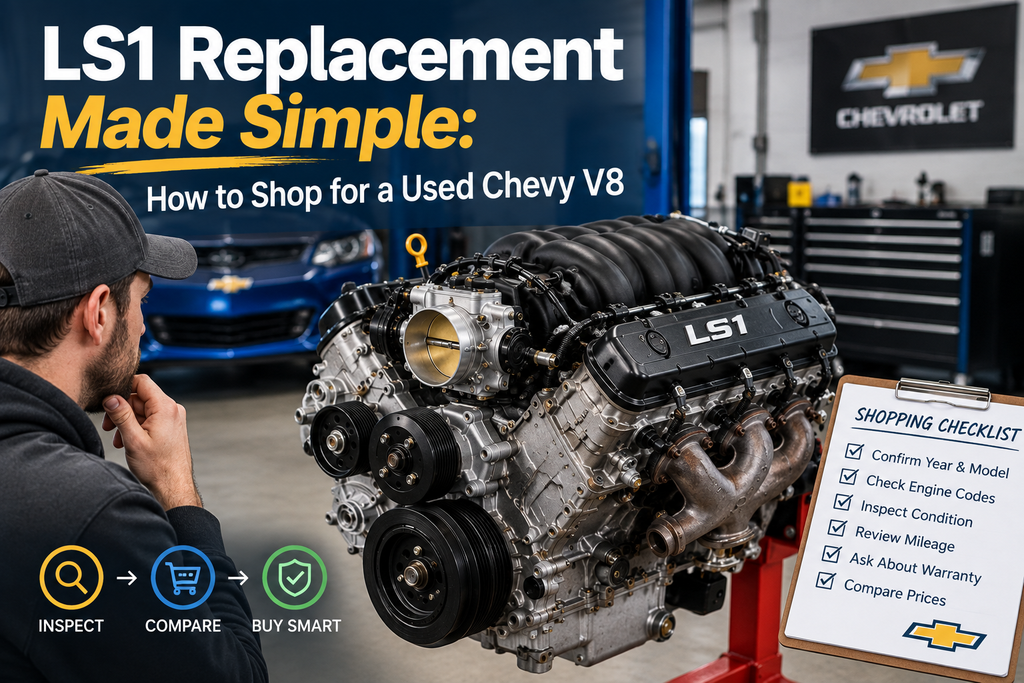
Are you replacing an original LS1 or using an LS1 for a different vehicle?
That distinction changes almost everything about your search.
For a direct replacement, you generally want an engine from the same or closely matching vehicle application. This can simplify wiring, accessories, sensors, engine management, mounting, and other installation details.
For an engine swap, you have more flexibility, but you also have more compatibility work to do. The engine itself may fit physically while its supporting components do not.
Before contacting a seller, gather:
- VIN
- Vehicle year and model
- Original engine information
- Transmission type
- Drive configuration
- Current modifications
- Intended use of the replacement engine
Providing this information early can make fitment discussions much more productive.
Understanding the LS1 Engine You Are Buying
The LS1 belongs to GM’s Gen III small-block V8 family and has a 5.7-liter displacement.
However, used-engine listings can describe very different products with similar terminology.
You might encounter:
- Complete engine assemblies
- Long-block engines
- Bare engine blocks
- Engines with intake systems
- Engines with fuel rails and injectors
- Engines with accessories
- Engines with wiring
- Engine-and-transmission packages
Before you compare two prices, determine whether the listings actually contain the same type of engine.
Complete Engine vs. Long Block
A complete engine may include several external components that can reduce the number of parts you need to source separately.
A long block generally provides the primary internal engine assembly while leaving some external components for you to reuse or purchase.
Neither option is automatically better.
The correct choice depends on what you already have and what your vehicle requires.
How to Identify the Right Used Chevy LS1 Engine
1. Start With the VIN
The VIN is one of the most useful pieces of information when confirming a replacement engine.
A model name alone may not provide enough information to establish the exact factory configuration. Give the seller the complete VIN and ask them to verify compatibility.
This is especially important if the vehicle has been modified or if the replacement engine comes from a different donor application.
2. Identify the Donor Vehicle
Ask where the engine originated.
A useful donor description should include information such as:
| Detail | Why It Matters |
| Donor make/model | Establishes original application |
| Model year | Helps identify configuration |
| Donor mileage | Provides useful history |
| Engine identification | Confirms the engine being sold |
| Running status | Gives context about removal |
| Inspection information | Helps evaluate condition |
| Previous modifications | May affect what you’re buying |
Knowing the donor vehicle also helps you determine which accessories may already be attached to the engine.
3. Confirm the Engine Configuration
Ask about components that could affect compatibility.
These may include:
- Intake manifold
- Throttle body
- Fuel injectors
- Fuel rails
- Accessory brackets
- Alternator
- Starter
- Sensors
- Oil pan
- Exhaust manifolds
- Wiring harness
- Engine controller
A replacement engine doesn’t need to include every one of these parts, but you should know what you’re getting before you purchase it.
How to Judge the Condition of a Used LS1
A used engine should be evaluated using more than mileage.
Donor Mileage
Mileage gives you useful information about how much the engine was used, but it does not tell the complete story.
Ask whether maintenance information is available and how the donor vehicle was used.
Engine Testing
If the seller has tested the engine, ask what was checked.
Depending on the engine and available information, testing may include:
- Compression
- Leak-down condition
- Oil pressure
- Crankshaft rotation
- External leaks
- Visual inspection
- Signs of coolant or oil contamination
The important point is to understand what was actually inspected, rather than treating the word “tested” as a complete description of engine health.
External Condition
Look carefully for:
- Cracks
- Corrosion
- Damaged connectors
- Broken brackets
- Missing sensors
- Oil leaks
- Coolant residue
- Damaged threads
- Signs of impact
Photographs can help, but ask questions about anything that isn’t clear.
Don’t Confuse Engine Mileage With Engine History
Two LS1 engines can have similar mileage and very different histories.
For example, one donor vehicle may have received regular maintenance while another may have been heavily modified or operated under demanding conditions.
When possible, consider:
Mileage + donor history + inspection information + visible condition
rather than mileage alone.
This is one of the most useful principles when comparing a used Chevy engine.
What Parts Should Come With the Engine?
This is one of the most important questions to answer before ordering.
A photograph may show an engine with several components attached, but that doesn’t necessarily mean every visible component is included.
Ask for a written or clearly stated list.
Components Worth Checking
Intake system
- Intake manifold
- Throttle body
- Related hardware
Fuel system
- Fuel rails
- Injectors
Ignition
- Coils
- Related ignition components
Accessories
- Alternator
- Starter
- Brackets
- Belt-related components
Electronics
- Sensors
- Wiring harness
- Engine controller, if applicable
Lower engine
- Oil pan
- Pickup-related components
Knowing what is included lets you calculate the actual replacement cost.
Buying an LS1 for a Direct Replacement
If your Chevrolet originally used an LS1 and the engine has failed, focus on finding a replacement with the closest practical application match.
Your priority list should be:
- Vehicle compatibility
- Engine identification
- Donor application
- Condition
- Mileage
- Included components
- Warranty
- Return policy
A close application match can reduce the amount of modification required during installation.
You should still compare the replacement engine with the original before installation rather than assuming every external component will transfer directly.
Buying an LS1 for an Engine Swap
An LS1 swap requires a different checklist.
Engine Mounts
Determine whether the receiving chassis requires specific mounts or brackets.
Oil Pan Clearance
The oil pan must clear the chassis, steering components, suspension, and crossmember.
Accessories
Accessory placement can affect clearance and belt routing.
Electronics
Check:
- Wiring
- Sensors
- ECU/PCM
- Throttle system
- Crank and cam signals
Fuel and Cooling
The receiving vehicle needs a fuel system and cooling system appropriate for the engine.
Transmission
Do not assume that your existing transmission, starter, flexplate/flywheel arrangement, or driveshaft will automatically work with the selected engine.
A successful LS1 swap is a complete drivetrain project, not simply an engine purchase.
Calculate the Total Cost Before Buying
The advertised engine price isn’t necessarily your final project cost.
Consider:
| Cost Area | What to Check |
| Engine | Purchase price |
| Shipping | Delivery charges |
| Installation | Labor |
| Seals/gaskets | Condition and replacement needs |
| Fluids | Oil, coolant, etc. |
| Accessories | Missing donor components |
| Electronics | Wiring or control requirements |
| Cooling | Radiator, hoses, related components |
| Fuel | Pump, lines, injectors, controls |
| Exhaust | Manifolds and fabrication |
| Swap hardware | Mounts and related parts |
This is particularly important for custom projects.
A lower-priced engine may require several additional components, while a more complete assembly could reduce the number of separate purchases.
What to Ask Before Buying a Used LS1
Before placing an order, ask the seller:
- What vehicle did the engine come from?
- What was the donor mileage?
- Was the vehicle running before the engine was removed?
- Is this the actual engine shown?
- What testing was performed?
- What components are included?
- Is it a complete assembly or long block?
- Are the intake and accessories included?
- Is the wiring harness included?
- What engine identification information is available?
- What warranty applies?
- What are the return requirements?
- Can fitment be confirmed using my VIN?
Clear answers to these questions can prevent many avoidable purchasing problems.
What to Do Before Installing the Replacement Engine
The installation process should include more than removing the old engine and dropping in the replacement.
First, investigate why the original engine failed.
If overheating caused the failure, inspect the cooling system.
If lubrication was involved, investigate the oil system.
If an electrical issue contributed to the problem, inspect the wiring and related controls.
Before installation, consider checking:
- Cooling system
- Radiator
- Hoses
- Thermostat
- Water pump
- Oil system
- Fuel system
- Engine mounts
- Wiring
- Battery and charging system
- Transmission connections
Fixing the original problem helps protect the replacement engine.
People Also Ask About Used Chevy LS1 Engines
1. What should I look for in a used Chevy LS1 engine?
Look at the donor vehicle, mileage, engine identification, condition, testing information, included components, compatibility, warranty, and return terms.
2. Is every Chevy 5.7L engine an LS1?
No. Displacement alone does not identify the exact engine family. Confirm the engine identification and donor application.
3. How can I confirm LS1 fitment?
Provide your vehicle’s VIN, year, model, original engine information, and transmission details and ask the seller to verify the replacement application.
4. Is a low-mileage LS1 automatically better?
No. Mileage should be considered together with donor history, maintenance information, inspection results, and overall condition.
5. Can an LS1 be used in an older Chevrolet?
An LS1 can be considered for a variety of swap projects, but the required mounting, wiring, fuel, cooling, exhaust, and transmission components depend on the receiving vehicle.
6. What is a long-block LS1?
A long block is the primary assembled engine section but typically does not include every external component found on a complete engine assembly. Confirm the exact contents of the listing.
7. Should I buy the engine and transmission together?
That depends on your application. A matched drivetrain package can be useful for some projects, but compatibility with the receiving vehicle still needs to be confirmed.
FAQs About a Used Chevy LS1 Engine for Sale
How much should I pay for a used LS1?
There is no single price that applies to every used LS1. Cost depends on factors such as application, mileage, condition, completeness, availability, and seller terms. Compare engines using the same criteria rather than price alone.
How many miles can a used LS1 last?
There isn’t a single mileage figure that determines whether a used engine is suitable. Actual condition depends on maintenance, operating history, modifications, and how the engine was treated.
Should I buy a complete LS1 or long block?
Choose based on what your project already has. A complete assembly can provide more components, while a long block can be practical if your existing accessories are compatible.
Can I reuse accessories from my old LS1?
Potentially, but verify compatibility first. Compare brackets, intake components, sensors, throttle configuration, and other external components before transferring parts.
Do I need the original ECU with a replacement LS1?
Not necessarily in every application. The appropriate engine-management setup depends on whether you’re performing a direct replacement or a custom swap.
What information should I give a seller?
Provide the VIN, year, model, transmission, original engine information, and intended use. For swaps, explain the receiving vehicle and planned configuration.
What should I do if the original engine failed because of overheating?
Inspect and repair the cooling system before installing the replacement. Otherwise, the same underlying problem could affect the replacement engine.
Used LS1 Engine Buying Checklist
Before purchasing, verify:
- VIN
- Vehicle year and model
- Original engine
- Donor vehicle
- Donor mileage
- Engine identification
- Testing information
- Visible condition
- Included components
- Oil-pan configuration
- Accessory configuration
- Wiring/electronics
- Warranty
- Return policy
- Shipping
- Installation requirements
For a swap, also confirm:
- Engine mounts
- Transmission compatibility
- Driveshaft requirements
- Fuel system
- Cooling system
- Exhaust
- ECU/PCM
- Throttle system
